
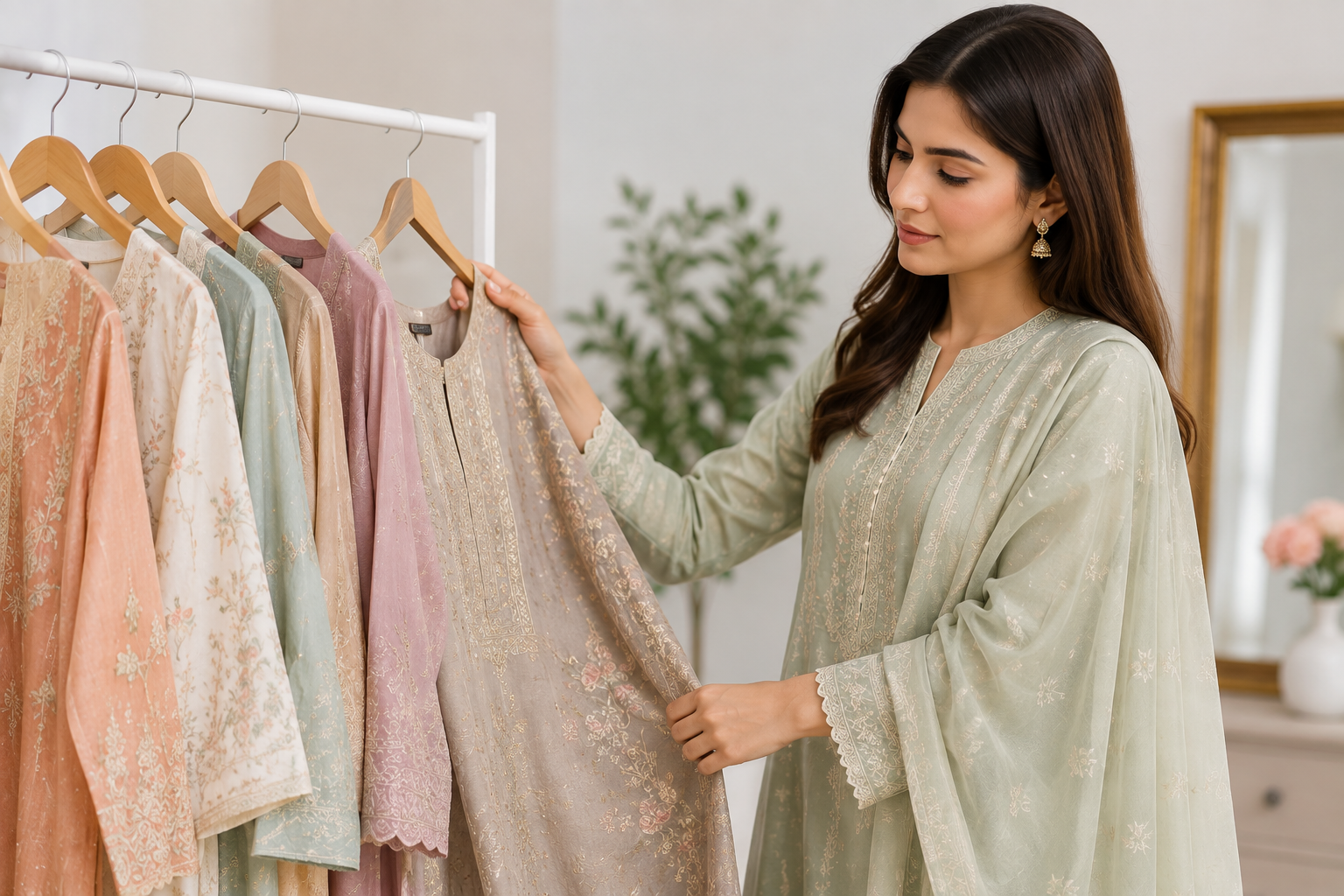
UK to Pakistani Suit Size: A Straightforward Conversion Guide (So You Stop Guessing)
If you've ever added a Pakistani suit to your basket, then closed the tab because you genuinely couldn't work out whether you needed a Medium or a Large, you're not alone. It's one of the questions we get asked most, and honestly, it's a fair one. A UK 12 doesn't sit neatly inside a Pakistani "M" the way it might on a UK high-street rail, and the sizing on a lot of Pakistani fashion sites can feel like it was written for a different planet.
We wanted to put together something genuinely useful rather than another generic size chart nobody reads properly. So here's how UK and Pakistani sizing actually relate to each other, why the numbers don't match up cleanly, and what to do when you're stuck between two sizes.
Why This Is Confusing in the First Place
Pakistani sizing wasn't built around the UK high-street system. Most brands size by bust measurement in inches, so a size labelled "36" simply means a 36-inch bust — not a UK dress size at all. That already trips people up, because we're used to seeing S, M, L or a number like 10 or 14 and assuming it means the same thing everywhere.
Then there's the fact that Pakistani suits are traditionally sold unstitched, meaning the fabric is cut and stitched to order rather than mass-produced in fixed sizes. Ready-to-wear has become far more common in the last decade, but the sizing habits from unstitched shopping still shape how the industry labels things. Add to that the simple reality that there's no single industry standard — one brand's Medium can genuinely differ from another's — and you can see why so many of us end up messaging customer service asking "but what does this actually mean in UK sizes?"
If you'd rather sidestep the guesswork altogether, our guide on how to measure yourself for a custom-stitched suit walks you through it properly — measurements don't lie, even when size labels do.
A Rough Conversion Chart (Treat It as a Starting Point)
We say "rough" deliberately. This gives you a sensible starting point, but it will not be exact for every brand.
|
UK Dress Size |
Approx. Bust (inches) |
Typical Pakistani Label |
|
UK 6–8 |
32–34" |
XS |
|
UK 8–10 |
34–36" |
S |
|
UK 10–12 |
36–38" |
M |
|
UK 12–14 |
38–40" |
L |
|
UK 14–16 |
40–42" |
XL |
|
UK 16–18 |
42–44" |
XXL |
A few honest caveats here. Traditional, heavily embellished cuts (think bridal or formal wear) tend to run slightly smaller through the shoulder and armhole than contemporary, western-influenced cuts. Fitted styles like a lehenga choli or a slim Anarkali need your actual bust and waist measurements far more than a size label can tell you, while flowier styles — maxis, straight-cut kameez, A-line silhouettes — are more forgiving if you land between two sizes.
Why Two "Mediums" Can Fit Completely Differently
This is the bit that catches people out even after they've checked a size chart carefully. A designer brand cutting for a fitted, structured silhouette and a casual lawn brand cutting for a relaxed daily-wear shirt can both label a piece "Medium" — and the finished garment can differ by two or three inches in the bust and waist. Neither brand is wrong. They're just working from different fit philosophies, and Pakistani fashion, unlike UK high-street retail, has never really standardised around one governing size system the way M&S or Zara have.
Our advice: always check the individual brand's size chart on the product page rather than relying on your usual UK size. If a chart isn't visible, or you want a second opinion, get in touch with us directly before you order — we'd genuinely rather answer a quick sizing question than deal with a return.
Ready-to-Wear vs Custom Stitched: Which Handles Sizing Better?
This is where the two shopping formats really diverge, and it's worth understanding before you decide which route to take.
|
Ready-to-Wear (Fixed Sizes) |
Custom Stitched (Your Measurements) |
|
|
Sizing risk |
Higher if you're between sizes |
Very low, since it's cut to you |
|
Best for |
Standard, predictable figures |
Anyone unsure of their UK-to-Pakistani size |
|
Speed |
Ships immediately |
Slightly longer, since it's made to order |
|
Alterations needed |
Sometimes |
Rarely |
If you're at all unsure where you land on a size chart, custom stitching genuinely removes the guesswork. You send us your measurements, we cut and stitch to them, and the whole "is this Pakistani Medium the same as my UK Medium" question becomes irrelevant. Our luxury pret collection has plenty of ready-to-wear pieces if you already know your fit, but if you're on the fence, going custom is the safer call.
What to Do If You're Between Two Sizes
This happens more often than you'd think, and there's no need to overthink it. A few practical rules we'd give a friend:
-
For fitted, structured pieces (lehengas, sharara sets, tailored kameez), size up rather than down. It's far easier for a local tailor to take a garment in slightly than to let it out.
-
For flowy, relaxed cuts (Anarkalis, straight suits, A-line kameez), you have more room to work with, and either size will usually sit fine.
-
For anything bridal or heavily embellished, don't guess — go custom stitched or contact the brand directly, since alterations on hand embroidery are far trickier and pricier than on plain fabric.
And if in doubt, our guide to choosing the right cut for your body shape is worth reading alongside any size chart, since the right silhouette often matters more than the label sewn into the collar.
What About Petite and Tall Frames?
Size charts tend to assume an "average" height, which doesn't help much if you're noticeably petite or tall. This is honestly one of the trickiest parts of shopping ready-to-wear Pakistani suits online, because bust and waist might match perfectly while the kameez length or trouser length sits completely wrong.
If you're petite, a standard-length kameez can end up mid-calf instead of knee-length, which changes the whole proportion of the outfit. If you're tall, the opposite happens — trousers can sit an inch or two too short, and sleeve length can feel slightly cropped. Neither is a huge problem, but it's worth knowing before you order rather than after.
Two practical fixes here. First, most UK sellers (us included) will happily shorten or lengthen a stitched piece for a small fee if you flag it at the point of order. Second, if length is a recurring issue for you specifically, custom stitching solves it in one go, since kameez length, sleeve length and trouser length are all part of the measurements we take anyway.
A Quick Word on Unstitched Fabric
If you've bought unstitched fabric before, none of this "size chart" conversation really applies to you in the same way — which is actually the appeal. You're buying yardage, not a garment, and a tailor cuts it to your body. Our guide on unstitched vs ready-to-wear breaks down which route makes more sense depending on how much control you want over the final fit.
Our Honest Take
If you take one thing from this guide, let it be this: don't trust a size label blindly, whatever the brand. Measure yourself once, keep those numbers saved on your phone, and check them against each brand's specific chart before you buy. It takes two extra minutes and saves you the hassle of a return.
You can browse our full collection or shop by category whenever you're ready, and if a size chart ever leaves you stuck, we're only a message away.
FAQs
1. What UK Size Is a Pakistani Medium?
Roughly a UK 10–12, though this varies noticeably between brands. Pakistani sizing is typically based on bust measurement in inches rather than the UK dress-size system, so it's worth checking the specific brand's chart rather than assuming Medium means the same thing everywhere.
2. How Do Pakistani Suit Sizes Compare to UK Sizes?
There's no exact one-to-one match. As a general guide, UK 6–8 is roughly XS, UK 10–12 is roughly M, and UK 14–16 is roughly XL, but this shifts depending on the cut and the brand. Fitted, embellished styles tend to run slightly smaller than relaxed, casual cuts.
3. Why Do Pakistani Suit Sizes Vary Between Brands?
Pakistani fashion has never standardised around a single sizing system the way UK high-street retail has. Different brands cut for different silhouettes, so two garments both labelled "Medium" can genuinely differ in bust and waist by a couple of inches. Checking each brand's own chart is always the safer approach.
4. Is It Better to Buy Stitched or Unstitched If I'm Unsure of My Size?
If you're unsure, custom stitching is usually the safer choice, since the garment is cut to your actual measurements rather than a fixed size label. Unstitched fabric works the same way, just with a local tailor doing the cutting. Fixed-size ready-to-wear carries more sizing risk if you're between sizes.
5. What Do I Do If I'm Between Two Sizes in a Pakistani Suit?
For fitted or structured pieces, size up, since taking a garment in is easier than letting it out. For flowy or relaxed cuts, either size typically works fine. For bridal or heavily embellished pieces, it's best to go custom stitched or contact the brand directly rather than guess.

Leave a comment
This site is protected by hCaptcha and the hCaptcha Privacy Policy and Terms of Service apply.