
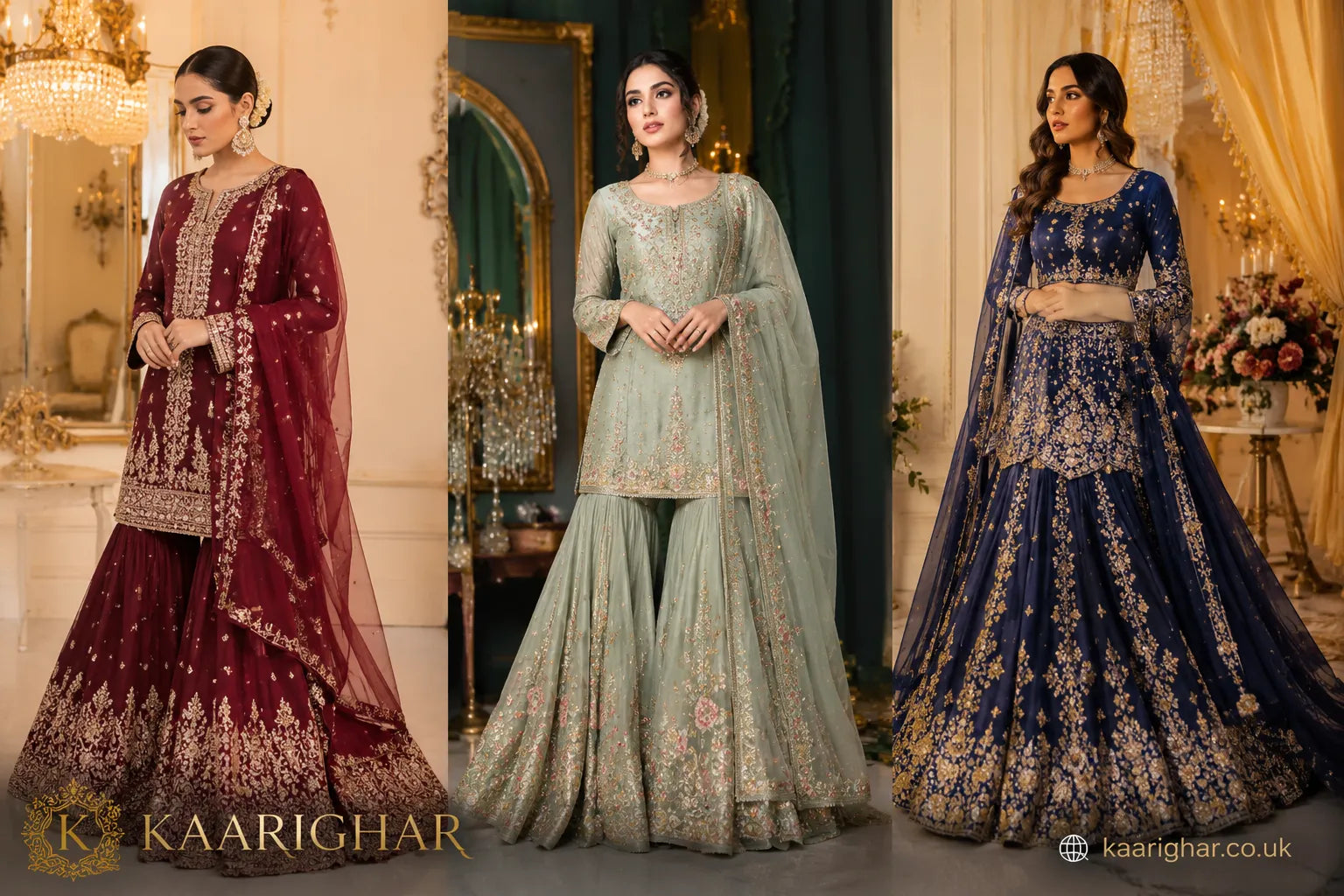
Gharara vs Sharara vs Lehenga: What Is the Difference and Which Should You Wear
Pakistani fashion has a vocabulary all of its own. And for shoppers new to the world of South Asian dressing, or for British-Pakistani women who grew up hearing these words at home but never quite untangled their meanings, three terms come up again and again: gharara, sharara, and lehenga.
All three are iconic silhouettes. All three appear at weddings, formal events, and festive celebrations. And all three look spectacular when worn correctly. But they are distinct garments with different constructions, different origins, and different suitability for different occasions and body types.
At Kaarighar, we field questions about gharara vs sharara vs lehenga every week, particularly from customers shopping for weddings, mehndi nights, and barat occasions. This guide is our definitive answer. By the end, you will know exactly what each silhouette is, where the flare starts, which occasions each suits best, and which one is right for your body and your event.
For occasion-specific guidance to go alongside this guide, read our Pakistani Wedding Fashion Guide 2026 and our dedicated mehndi outfit ideas guide.
What Is a Gharara? Definition, Origin and Construction
The gharara is one of the oldest and most culturally significant garments in the Pakistani and South Asian fashion tradition. Its origins trace back to the Mughal courts of the sixteenth and seventeenth centuries, where it was worn by noblewomen as a garment of formality and status. The word itself is thought to derive from the sound the heavy, flared fabric makes as it moves, an onomatopoeic reference to the rustle and swish of the silk.
What Does a Gharara Look Like?
Structurally, a gharara consists of:
-
A short kameez (typically falling to just above or at the knee)
-
Wide, divided trousers that flare dramatically from the knee downward
-
A dupatta worn over the outfit
The defining feature of the gharara is precisely where the flare begins: at the knee. Above the knee, the trousers are fitted and straight. Below the knee, they open into an extravagant, sweeping flare that pools on the floor and creates the visual impression of a skirt in motion.
This knee-to-floor flare is what makes the gharara so immediately distinctive. When a woman in a gharara walks or dances, the fabric moves with theatrical drama. Under wedding hall lighting, the effect is genuinely spectacular.
What Is a Farshi Gharara?
The farshi gharara is the most extreme and historically prestigious form of the gharara. The word farshi means floor-length or ground-sweeping, and the farshi gharara takes the flare of the standard gharara to its most dramatic conclusion: the fabric trails significantly behind the wearer, sometimes by several feet.
The farshi gharara was the garment of Mughal royalty and has experienced a revival in contemporary Pakistani bridal fashion, particularly for brides who want the most historically rooted and visually spectacular barat look possible. It requires a great deal of fabric, significant embellishment investment, and ideally a helper to manage the train during the ceremony.
In the UK, the farshi gharara is most commonly seen on brides at very formal, large-scale barat events. It is not a practical choice for mehndi or walima, where the ability to move freely matters more.
What Is a Sharara? Definition and Construction
The sharara is closely related to the gharara in cultural lineage but differs crucially in construction. Like the gharara, it is a wide-legged trouser garment worn with a kameez and dupatta. The key difference is one that confuses many shoppers: where the flare begins.
Where Does the Flare Start in a Sharara?
In a sharara, the flare begins at the hip rather than the knee. This means the entire length of the trouser leg is wide and flared, from the very top of the waist to the hem. There is no fitted section above the knee. The result is a garment with an all-over volume that is wider, fuller, and in some ways more dramatic than a gharara, because the flare is present throughout the entire length of the leg.

Gharara vs Sharara: The One Difference That Matters
To make this permanently clear:
|
Feature |
Gharara |
Sharara |
|
Where does the flare start? |
At the knee |
At the hip |
|
Is the upper leg fitted? |
Yes, above the knee |
No, wide throughout |
|
Overall volume |
Dramatic at the hem |
Dramatic throughout |
|
Silhouette impression |
Fitted top, dramatic bottom |
Wide and voluminous overall |
|
Cultural association |
Mughal formal tradition |
Pre-wedding and festive occasions |
|
Best occasion |
Barat, formal events |
Mehndi, semi-formal, festive |
This single distinction, where the flare begins, is the entire difference between the two garments. Everything else, the kameez, the dupatta, the fabric, the embellishment, can be identical between a gharara and a sharara set.
What Is a Lehenga? Definition and How It Differs
The lehenga is structurally the most different of the three. While both the gharara and the sharara are trouser garments (divided at the centre), the lehenga is a skirt. It is a single, undivided circular or semi-circular garment worn at the waist, falling to the floor in a full, flared silhouette. It is paired with a choli (fitted bodice or blouse) and a dupatta.
How Is a Lehenga Different from a Gharara?
The most important distinction is this: a lehenga is a skirt with no division between the legs. A gharara and a sharara are both trouser garments, meaning the fabric is divided into two separate legs. When the wearer moves, the difference is visible, though when standing still, a heavily flared gharara can look almost indistinguishable from a lehenga.
|
Feature |
Lehenga |
Gharara |
Sharara |
|
Construction |
Skirt (undivided) |
Trouser (divided at knee) |
Trouser (divided at hip) |
|
Paired with |
Choli (blouse) |
Short kameez |
Short or mid-length kameez |
|
Flare type |
Circular or semi-circular |
Knee-to-floor trouser flare |
Hip-to-floor trouser flare |
|
Movement |
Skirt swish |
Dramatic trouser sweep |
Full-length volume |
|
Cultural roots |
Rajasthani and South Asian |
Mughal court tradition |
Mughal and festive tradition |
|
Occasion |
Barat, formal, Bollywood-influenced |
Barat, mehndi, formal |
Mehndi, festive, semi-formal |
Which Occasions Suit Each Silhouette?
Gharara: Best for Barat and High Formal Occasions
The gharara is at its finest in the most formal settings. The barat, the nikah, a high-end formal dinner. Its Mughal heritage gives it a sense of cultural gravitas that the other two silhouettes do not quite match, and its below-the-knee construction makes it slightly easier to walk and sit in than a heavily weighted lehenga.
Our Faiza Saqlain Zinnia Peony is a beautifully constructed formal piece in the Zinnia collection that lends itself to the gharara aesthetic, with the kind of fine embellishment and silhouette engineering that works perfectly for barat occasions. Browse our full luxury formals collection for more high-occasion options.
Sharara: Best for Mehndi, Festive Events and Semi-Formal Occasions
The sharara's all-over volume and free-flowing movement make it the natural choice for mehndi dressing, festive celebrations, and semi-formal events where freedom of movement is as important as visual impact. Its hip-to-floor flare creates a beautifully dramatic silhouette on the dance floor and photographs with particular vibrancy under festive lighting.
The Ayzel Luminara Wedding Formal 24 in Mela is one of our most popular sharara-adjacent wedding formal picks for pre-wedding and festive occasion dressing. For the full range of options suited to mehndi and festive events, explore our Pakistani women's wedding outfits collection.
Lehenga: Best for Barat, Bridal, and High-Impact Formal Events
The lehenga is the most internationally recognisable of the three silhouettes and carries the strongest visual association with South Asian bridal dressing. In the UK, lehenga is often the first silhouette British-Pakistani brides consider for their barat look, thanks to its sweeping drama and the photographic impact of the full skirt silhouette.
The Afrozeh Shehnai Wedding Formals 24 in Tazmeen is a formal piece with the kind of full, embellished construction that complements a lehenga's grandeur, ideal for brides and bridal party guests at barat events. Read our barat outfit ideas guide for more on dressing for this occasion.
Which Silhouette Suits Which Body Type?
This is one of the most practical questions we receive at Kaarighar, and the answer is nuanced because all three silhouettes can work beautifully for every body type with the right construction and embellishment choices.
|
Body Type |
Best Silhouette |
Why |
|
Hourglass |
All three work |
The defined waist is naturally highlighted by all three silhouettes |
|
Pear shape |
Gharara or lehenga |
Volume below the waist balances the figure; gharara's fitted top draws the eye upward |
|
Apple shape |
Sharara |
All-over volume avoids the fitted waistband that can be uncomfortable; the hip-to-floor flare skims the midsection |
|
Rectangle |
Lehenga or sharara |
Maximum volume creates the illusion of curves |
|
Petite |
Gharara (lighter fabric) |
Knee-start flare creates length; avoid heavily weighted lehenga trains |
|
Tall |
All three work |
Tall figures carry all three silhouettes with natural elegance |
A critical note: the fabric weight affects how flattering each silhouette is for different bodies. A gharara in light chiffon behaves very differently from a gharara in heavy raw silk. For a deeper understanding of fabric choices, read our Pakistani lawn vs chiffon vs organza fabric guide.
Which Is Better for a Wedding: Gharara or Sharara?
This is perhaps the single most searched question in the gharara vs sharara conversation, and the honest answer is: it depends on which wedding function you are attending.
For the barat, the gharara edges ahead in cultural formality. Its Mughal heritage, fitted upper section, and dramatic below-the-knee flare make it the more ceremonially appropriate choice for the main wedding event.
For the mehndi, the sharara is the stronger choice. Its all-over volume, ease of movement, and festive energy make it more suited to a pre-wedding celebration than the structured formality of a gharara.
For the walima, a lighter gharara in chiffon or organza works beautifully as a more composed alternative to the barat's heavier construction. A three-piece formal suit is also equally appropriate at walima level.
For guests, both the gharara and the sharara are excellent choices for wedding occasion dressing. The most important considerations are your own comfort, how much you plan to dance, and how much embellishment is appropriate for the specific function.
Our Faiza Saqlain Zinnia Lily is a refined formal option that bridges barat and semi-formal dressing beautifully. Browse our full Pakistani women's wedding outfits range and the complete formal collection at Kaarighar to find the right silhouette for your occasion.
Quick Reference: Gharara vs Sharara vs Lehenga at a Glance
|
Question |
Gharara |
Sharara |
Lehenga |
|
What is it? |
Trousers flaring from the knee |
Trousers flaring from the hip |
A full circular skirt |
|
Where does the flare start? |
Knee |
Hip |
N/A (full skirt) |
|
Best occasion |
Barat, formal, nikah |
Mehndi, festive, semi-formal |
Barat, bridal, high formal |
|
Best fabric |
Raw silk, velvet, chiffon |
Chiffon, net, organza |
Raw silk, velvet, organza |
|
Best for |
Hourglass, pear, petite |
Apple, rectangle, all shapes |
Rectangle, tall, hourglass |
|
Cultural origin |
Mughal courts |
Mughal and festive tradition |
Rajasthani and South Asian |
|
Bridal use |
Yes, especially farshi |
Mehndi bridal look |
Yes, most common bridal choice |

Most Asked FAQs
Q1. What is the difference between a gharara and a sharara?
The key difference is where the flare begins. In a gharara, the trouser leg is fitted from the waist to the knee, then opens into a dramatic flare from the knee to the floor. In a sharara, the flare begins at the hip, meaning the entire trouser leg is wide and voluminous from top to bottom. Both are divided trouser garments worn with a kameez and dupatta. For occasion-specific guidance, read our mehndi outfit ideas guide and barat outfit ideas guide.
Q2. How is a lehenga different from a gharara?
A lehenga is a skirt. It has no division between the legs and is worn as a single circular or semi-circular garment at the waist. A gharara, by contrast, is a trouser garment with two divided legs that flare dramatically from the knee. When standing still, a heavily flared gharara can appear similar to a lehenga, but the construction and movement are quite different. Lehengas are typically paired with a choli (blouse), while gharara are worn with a short kameez. Browse our luxury formals for both options.
Q3. What is a farshi gharara?
A farshi gharara is the most dramatic and historically prestigious form of the gharara. The word farshi means floor-sweeping, and the farshi gharara features an extremely long, trailing flare that pools several feet behind the wearer. Associated with Mughal royalty, it has been revived in contemporary Pakistani bridal fashion and is most commonly worn by brides at formal barat events in the UK. It requires significant fabric investment and embellishment, and is one of the most visually spectacular silhouettes in the Pakistani fashion tradition.
Q4. Which silhouette is better for a wedding: gharara, sharara or lehenga?
For the barat and formal wedding events, gharara and lehenga are both strong choices, with the lehenga being the most widely chosen bridal silhouette overall. For the mehndi, sharara is the most appropriate because its all-over volume and ease of movement suit the festive, dance-focused energy of the occasion. For guests, the best choice depends on the specific function, your body type, and your comfort preferences. Explore our Pakistani women's wedding outfits for curated options across all three silhouettes.
Q5. Which silhouette suits a petite body type best?
For petite women, the gharara is generally the most flattering of the three silhouettes. Its fitted upper section creates vertical length through the body, while the below-the-knee flare adds drama without overwhelming a smaller frame. It is important to choose lightweight fabrics like chiffon or net rather than heavily weighted silk or velvet, which can overwhelm a petite figure. A sharara also works well in lighter fabrics. A full, heavy lehenga can visually shorten a petite frame, so if you love the lehenga silhouette, keep the fabric light and the hemline precise. For more body shape guidance, read our how to choose the perfect Pakistani dress for your body shape guide at Kaarighar.
Shop gharara, sharara and lehenga styles from Pakistan's finest designers at kaarighar.co.uk with next-day UK delivery available.

Leave a comment
This site is protected by hCaptcha and the hCaptcha Privacy Policy and Terms of Service apply.