
Article: Sister of the Bride: The Complete Bridal Party Outfit Guide for UK Weddings
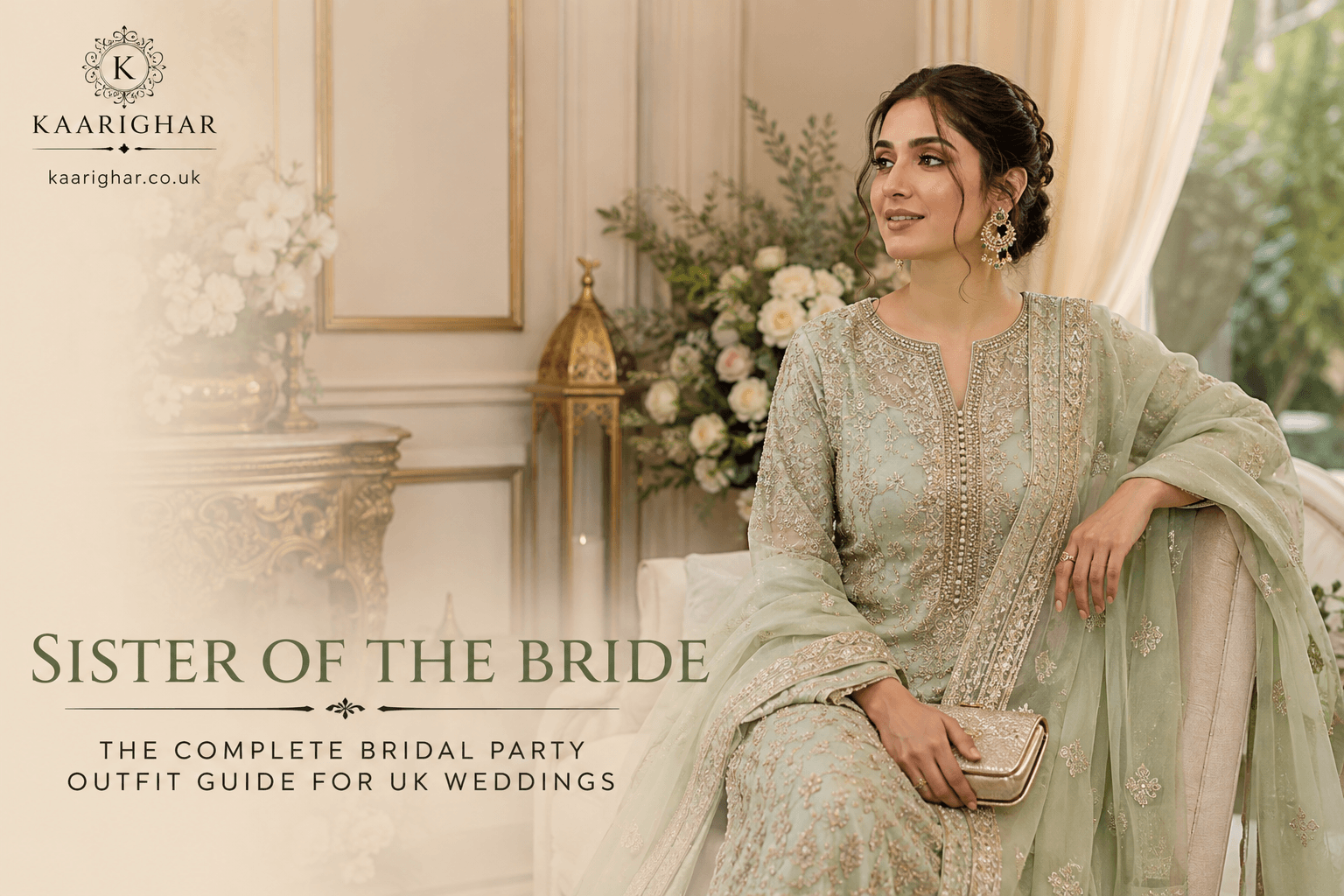
Sister of the Bride: The Complete Bridal Party Outfit Guide for UK Weddings
Being the bride's sister at a Pakistani wedding comes with more outfits, more responsibility, and more time in front of the camera than almost any other role at the event. You're in the getting-ready shots, the Mehndi dance videos, half the Barat entrance, and every family photo that follows. Unlike a regular guest, you can't just pick something nice and show up — you're part of the visual story of the wedding, often across three or four separate functions, sometimes coordinating with other sisters, cousins or the wider bridal party at the same time.
We've put this guide together specifically for that role, covering how to dress for each function, how group coordination actually works in practice, and where to shop for it without spending the whole summer scrolling through options.
How This Role Is Different From Being a Guest
A regular guest has one outfit to think about and complete freedom over what it looks like. As a sister of the bride or a member of the bridal party, you're usually dressing for multiple functions, often need to loosely coordinate with other sisters or cousins for at least one of them, and are expected to look polished without ever pulling attention away from the bride herself.
That last point matters more than people expect. It doesn't mean dressing down — bridal party outfits are often some of the most elaborate at the whole wedding — but it does mean being aware of colour and formality relative to the bride's outfit for each specific function, particularly during the Barat and Walima.
What to Wear, Function by Function
Mehndi is where this role gets the most freedom, and usually the most fun. If you're performing in the Mehndi dances, movement matters as much as colour — lighter fabrics like georgette or chiffon hold up far better through choreography than anything too structured or heavy. Bright yellows, oranges and greens remain the traditional palette, though many UK bridal parties now build a loosely coordinated colour story across two or three complementary shades rather than everyone wearing exactly the same thing.
Nikkah calls for something more modest and considerably less bright than the Mehndi outfit — this is a religious ceremony, and outfits here tend to be simpler, with softer colours and more coverage.
Barat is usually where sisters of the bride wear their most elaborate outfit of the wedding. Rich embroidery, structured silhouettes and jewel tones dominate here, and it's common for the bride's closest sisters to coordinate more closely with each other than with the wider bridal party. If you're deciding between a gharara, sharara or lehenga for this one, our gharara vs sharara vs lehenga guide breaks down which silhouette suits which body type and how each one holds up across a long day of standing, dancing and photographs.
Walima tends to be the most refined function of the four, with pastels, ivories and soft metallics increasingly common — though as the bride's sister, it's worth checking what she's planning to wear before committing to anything too close in shade.
This season's Mehndi colours and styling are shifting slightly toward richer jewel tones alongside the traditional brights, which is worth keeping in mind as you and the rest of the bridal party settle on a palette.
Coordinating With Other Sisters and Bridesmaids
Group coordination at UK Pakistani weddings has moved away from everyone wearing an identical outfit, which tends to look flatter in photographs than people expect. What works better is a shared colour palette with individual variation in silhouette — one sister in a sharara, another in a fitted Anarkali, a third in a structured shirt with palazzo trousers, all in complementary shades of the same colour family. It reads as coordinated without looking like a uniform, and it means everyone can choose a silhouette that actually suits them.
If the bride has a specific colour scheme in mind for the bridal party, it's worth confirming this early — fabric availability and delivery timelines during peak wedding season mean coordinated group orders need more lead time than a single outfit does. It's also worth agreeing on formality levels as a group, not just colour — one sister in heavy embellishment next to another in something much plainer tends to stand out in photographs in a way that colour mismatches alone don't.
Silhouettes That Work for Dancing and Long Days
Because this role usually involves more movement than a typical guest outfit — Mehndi choreography, standing through long Barat receptions, moving between venue spaces — silhouette choice matters more than it might for someone just attending as a guest. A fitted sharara with a shorter shirt offers more freedom of movement than a heavily structured gown, while a well-cut Anarkali balances formality with enough ease to actually dance in without worrying about the fit.
Our guide to choosing the perfect Pakistani dress for your body shape is worth reading before you order anything for this role specifically, since getting the neckline and silhouette right matters more when you know you'll be dancing, posing and moving through several hours of photography rather than sitting for most of the event.
Accessorising for Photos and Movement
Jewellery for this role can carry more than a guest outfit would, but it still needs to survive a full day of movement. Statement earrings and a layered choker work well for Barat and Walima, but for the Mehndi specifically, it's worth choosing pieces that won't catch on fabric or come loose mid-performance — smaller stud earrings and lighter bangles tend to hold up better through choreography than anything with long, dangling elements.
Footwear matters just as much as the outfit itself here. A low block heel or an embellished flat gives enough support to get through hours of standing, dancing and photographs without the outfit losing any of its formality in pictures. Many UK bridal parties now pack a second, more comfortable pair specifically for the Mehndi dance portion, switching back to heels once the performance is done.
Getting the Fit Right
Because bridal party pieces are often ordered as a coordinated group, sizing mistakes are more common here than with a single guest outfit — everyone's ordering at once, often from a size chart rather than trying anything on, and there's rarely time to fix a fit issue once the wedding is close. It's worth having every sister or bridesmaid check their measurements individually rather than assuming standard sizing will work the same across designers.
Our UK to Pakistani suit size conversion guide is a useful reference to share across the group before anyone places an order, particularly if you're mixing designers within the same coordinated look.
Where to Shop
Zaha is a strong option for this role — the brand leans toward festive, youthful silhouettes with enough embellishment to feel occasion-appropriate without tipping into anything too formal for Mehndi or Nikkah. Our Zaha collection is worth browsing for exactly this, and a piece like the Ayzel Pehli Nazar in Nazrana shows the kind of festive, photograph-ready piece that suits a Mehndi or pre-wedding function well.
For Barat and Walima pieces with more structure, our luxury pret collection brings together several designers in one place, while our broader Pakistani wedding party wear collection is the fastest way to browse across colour and formality levels if you're still deciding on a direction. If a lehenga is on your shortlist for the Barat, our lehenga collection is worth a look too.
Frequently Asked Questions
1. What Should the Sister of the Bride Wear to a Pakistani Wedding?
The sister of the bride typically needs a separate outfit for each function — a lighter, movement-friendly piece for Mehndi, something modest for Nikkah, and more formal, richly embroidered pieces for Barat and Walima, while staying mindful of not matching the bride too closely.
2. Do Bridal Party Outfits Need to Match Exactly?
No — most UK bridal parties now favour a shared colour palette with varied silhouettes rather than identical outfits, which tends to photograph better and lets everyone choose a shape that suits them individually.
3. What Fabric Is Best for Dancing at a Mehndi?
Lighter fabrics like georgette and chiffon tend to hold up best through Mehndi choreography, offering more freedom of movement than heavier, more structured fabrics like velvet or raw silk.
4. How Far in Advance Should Bridal Party Outfits Be Ordered?
Coordinated group orders generally need more lead time than a single guest outfit, particularly during peak UK wedding season in October and November, so it's worth confirming the colour scheme and placing orders at least six weeks ahead.
5. Should the Bride's Sister Avoid Certain Colours?
White and ivory are generally reserved for the bride, and it's worth checking the bride's planned colour for each function before finalising anything too similar, particularly for the Barat and Walima.

Leave a comment
This site is protected by hCaptcha and the hCaptcha Privacy Policy and Terms of Service apply.