
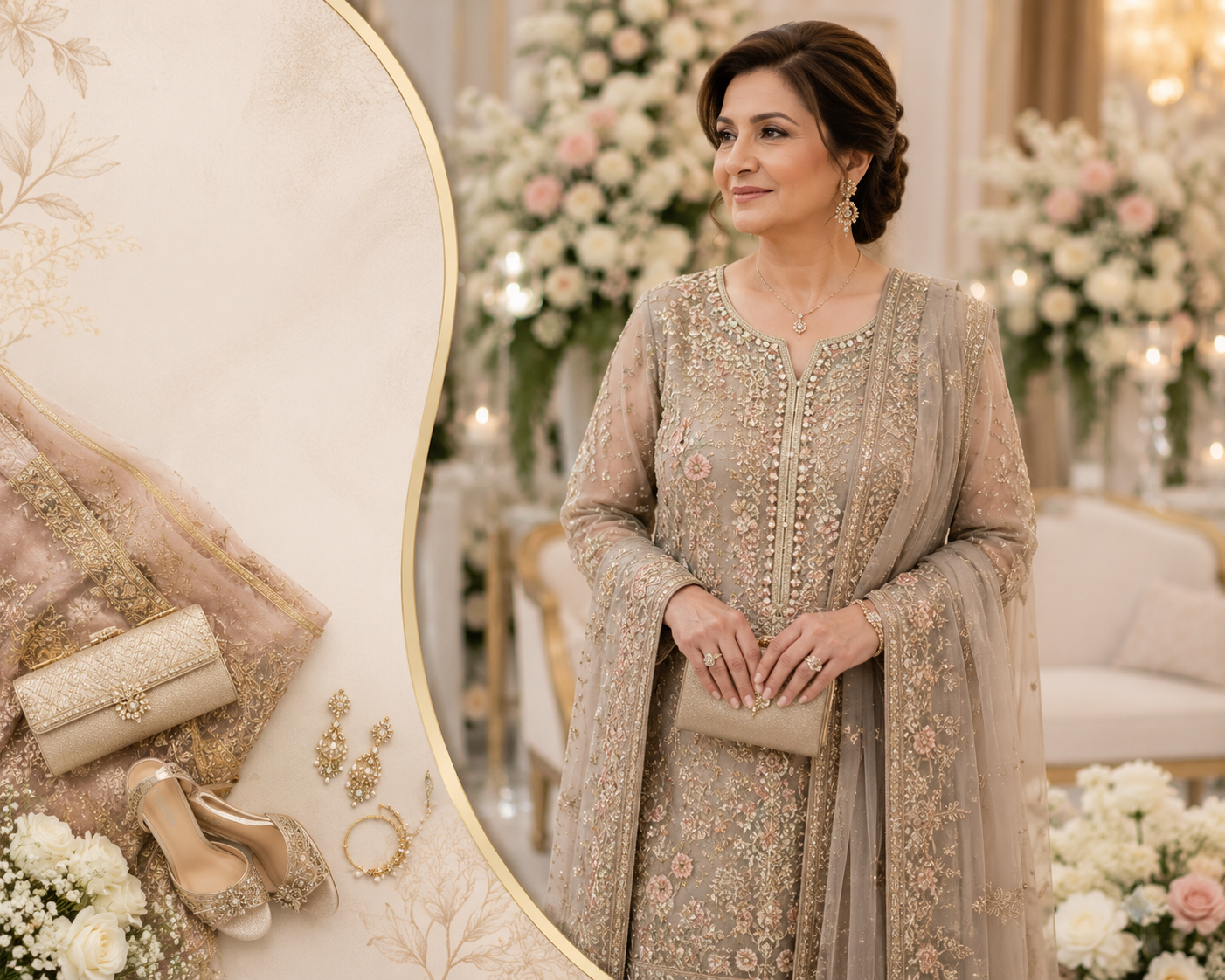
Mother of the Bride & Groom: Pakistani Wedding Outfit Guide (UK)
There's a strange gap in Pakistani wedding fashion content, and it's this: almost everything is written for the bride, the bridesmaids, or the twenty-something guest scrolling Pinterest for outfit inspiration. Mothers of the bride and groom — the women who arguably have to look composed and elegant for the longest stretch of the entire day, often across multiple functions — get almost nothing written specifically for them.
We think that's worth fixing. So this one's for the mums. Whether you're the mother of the bride trying not to be outshone by your own daughter (a real and valid concern, by the way) or the mother of the groom trying to strike the right note of elegance without overreaching, here's what actually works.
The Unwritten Rule: Elegant, Not Competing
If there's one piece of advice that comes up every single time we help a mother of the bride or groom choose her outfit, it's this: the goal is to look beautiful and put-together, not to compete with the bride. That doesn't mean dressing down — far from it. It means choosing pieces with real presence and quality, but leaving the most elaborate, heaviest bridal embellishment to the bride herself.
In practice, this usually looks like rich fabric, tasteful embroidery concentrated on the neckline and hem rather than covering the entire garment, and a colour that complements the day's palette without directly matching the bride's outfit. A well-chosen formal suit in a jewel tone with refined zari or dabka work almost always strikes the right balance.
Mother of the Bride vs Mother of the Groom: Is There a Difference?
Genuinely, yes, though it's more about tradition than any strict rule. In many Pakistani families, the mother of the groom takes on a slightly more prominent, formal role during the barat, since it's traditionally seen as "her side" welcoming the bride into the family. This can mean a marginally more elaborate outfit at that specific function.
The mother of the bride, meanwhile, often has more outfit changes to plan for across the wedding functions — mehndi, nikah, barat, walima — since she's typically present and visibly involved at every single one. Comfort across long days genuinely matters here, which we'll come back to.
Neither role has a fixed rulebook, though, and plenty of families do things differently. The honest answer is: dress for the specific function, in a way that feels like you, rather than following a rigid formula.
What to Wear, Function by Function
Mehndi: Bright, festive colours work beautifully here — mustard, coral, turquoise, deep pink. A flowing Anarkali or elegant kameez with lighter embroidery suits the celebratory, slightly informal tone of the mehndi far better than anything too structured or heavy.
Nikah: Softer, more refined tones are the safer choice — think dusty rose, sage, powder blue, or a muted gold. Given the more intimate, religious nature of the nikah, a well-tailored, modestly cut suit with understated embroidery reads as appropriately elegant.
Barat: This is where you can lean into a richer, more formal look. Deep jewel tones, refined zari or gota work, and a more structured silhouette all suit the grandeur of the day. Our luxury formals collection has plenty of pieces built exactly for this level of occasion.
Walima: Slightly softer than the barat but still formal — gold, champagne, blush, or a lighter jewel tone with elegant embellishment works well. For something with a touch more shine without the full weight of barat-level embroidery, our wedding outfits collection covers this range nicely.
Fabric and Comfort Matter More Than People Admit
Here's something that doesn't get said enough: a mother of the bride or groom is often on her feet, greeting guests, managing logistics, and sitting through hours-long functions across several days. An outfit that looks stunning in photos but feels restrictive by hour three is genuinely the wrong choice, however beautiful it looks on the hanger.
Georgette and silk blends tend to be the sweet spot — they hold a formal shape and catch the light beautifully, but they move and breathe far better than stiff, heavily structured fabric. If a particular function runs long or involves a lot of standing and greeting, it's worth prioritising comfort in that fabric choice specifically, even if it means saving the heaviest, most structured piece for a shorter, seated function.
Colours That Flatter Without Overshadowing
Deep jewel tones — emerald, sapphire, plum, burgundy — are almost universally flattering and read as elegant without competing with a bride's traditional red or a groom's more neutral palette. Gold, champagne, and blush also work beautifully, particularly for walima or reception-style events.
What's generally worth avoiding is wearing the exact colour the bride has chosen for a given function, since it can read as an unintentional clash in photos. A quick conversation with the bride or groom beforehand about the day's colour palette avoids this entirely and is honestly worth having regardless.
Getting the Fit Right
For mature women in particular, fit tends to matter even more than embellishment when it comes to looking genuinely elegant. A well-tailored A-line or straight-cut kameez, cut to your actual measurements, will always look more polished than an off-the-rack piece that's slightly too tight or too loose. If you're custom stitching, our guide on how to measure yourself for a custom-stitched suit covers exactly what we need to get the fit right the first time.
Modest, elegant coverage — full or three-quarter sleeves, a flattering neckline, a well-proportioned length — tends to be the most universally requested silhouette for this role, and our modest wear collection is a good place to start browsing if that's the direction you're leaning.
Accessories: Finishing the Look Without Overdoing It
Jewellery and accessories deserve the same "elegant, not competing" thinking as the outfit itself. A statement necklace paired with a formal barat suit can look wonderful, but layering multiple heavy pieces at once — a choker, long earrings, several bangles, an ornate maang tikka — often ends up fighting the outfit rather than finishing it. One or two well-chosen statement pieces, rather than everything at once, almost always photographs better.
A good shawl is worth investing in properly. It works across several functions, adds warmth for a UK evening reception, and can transform a slightly simpler daytime outfit into something formal enough for an evening event without needing an entirely separate piece. Embroidered velvet or a fine pashmina in a complementary tone both work well, depending on the season.
Footwear is the detail most often overlooked, and it shouldn't be. Across a multi-day wedding, comfort in your shoes matters just as much as how they look standing still for photographs. A low block heel or an elegant flat, chosen to complement rather than exactly match the outfit, tends to hold up far better across a long day than a very high heel that looks stunning for the first hour and becomes unbearable by the third.
A Few Honest Tips
A handful of things we'd genuinely tell a friend in this position, beyond the obvious styling advice. Plan your outfits for all the functions together, not one at a time, so the colours and formality levels feel considered as a set rather than randomly assembled. Break in any new footwear well before the wedding — nobody remembers a beautiful outfit fondly if it was paired with blisters. And don't underestimate a well-chosen shawl or dupatta layer; it's an easy way to elevate an outfit for a more formal function without needing an entirely new piece.
In Short
The mother of the bride or groom deserves an outfit that feels as considered and beautiful as anyone else's at the wedding — just calibrated slightly differently, with elegance and comfort taking priority over maximum embellishment. Browse our full collection whenever you're ready, and if you'd like guidance on which pieces suit a specific function, we're always happy to help you plan it out properly.
FAQs
1. What Should the Mother of the Bride Wear to a Pakistani Wedding?
An elegant, well-tailored formal suit in a rich colour with refined embroidery, chosen to complement rather than compete with the bride's outfit. Comfort matters across the long day, so georgette or silk-blend fabrics that move well are usually a better choice than very stiff, heavily structured pieces.
2. Is It Different for the Mother of the Groom Compared to the Mother of the Bride?
There's no strict rule, but in many families the mother of the groom takes a slightly more prominent role during the barat, which can mean a marginally more formal outfit for that function. The mother of the bride is typically present and dressed for every function, so planning outfits across the whole event matters more for her.
3. What Colours Suit an Older Woman at a Pakistani Wedding?
Deep jewel tones like emerald, sapphire, plum and burgundy are consistently flattering and elegant, while gold, champagne and blush work beautifully for walima or reception-style events. It's worth checking the bride or groom's chosen colours beforehand to avoid an unintentional clash in photos.
4. Should the Mother of the Bride Wear Something Less Embellished Than the Bride?
Generally, yes. The convention is to look elegant and beautifully dressed without competing with the bride's own outfit, which usually means concentrating embroidery on the neckline and hem rather than covering the whole garment, and choosing refined rather than maximum embellishment.
5. What Fabrics Are Most Comfortable for an Older Woman at a Long Wedding Event?
Georgette and silk blends tend to be the best balance of formal appearance and comfort, since they hold their shape and catch the light beautifully while still moving and breathing well. For functions involving a lot of standing or greeting guests, prioritising a comfortable fabric is genuinely worth it.

Leave a comment
This site is protected by hCaptcha and the hCaptcha Privacy Policy and Terms of Service apply.